
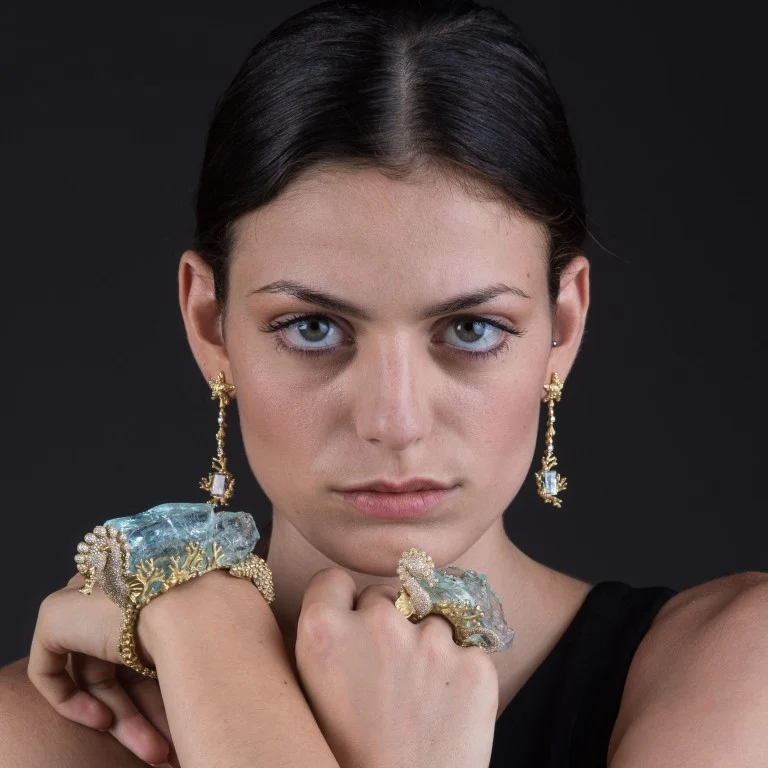

For centuries, the world of fine jewelry was governed by strict rules of symmetry, perfection, and geometry. Master lapidaries spent decades perfecting the art of the brilliant cut, transforming rough mineral specimens into mathematically calculated prisms of light and fire. Round brilliants, emerald cuts, and princess cuts became the universal language of luxury, dictating that a gemstone’s true value lay in its ability to refract light through perfectly flat facets and sharp angles.
However, modern design philosophy is undergoing a quiet rebellion. Today, contemporary jewelry designers, interior stylists, and fashion houses are turning away from mass-produced uniformity in favor of nature’s original blueprints. Raw, uncut, and unpolished gemstones are stepping out of the shadows of the laboratory and taking center stage in high-end collections. This shift represents a profound cultural appreciation for authenticity, individuality, and the raw power of the natural world.
The Philosophy of Imperfection
At the heart of the raw gemstone trend is an embrace of organic imperfection. In a world increasingly dominated by digital screens, manufactured precision, and artificial intelligence, human beings crave tactile connections to the physical earth. A faceted diamond or sapphire undergoes intense human intervention before it ever reaches a retail display case. It is sliced, diced, ground, and polished until every trace of its geological history is erased.
Uncut gemstones, by contrast, tell a complete story. When you look at a rough crystal, you are gazing at a geological fingerprint formed over millions of years under intense heat and pressure deep within the Earth’s crust. Every striation, natural growth line, inclusion, and irregular contour is a record of the environment in which the crystal grew.
-
Geological Context: Rough stones retain their crystal habit, showing how the mineral naturally grew in nature rather than how a machine forced it to look.
-
Unique Identity: No two rough stones are alike, ensuring that a piece of jewelry crafted from raw minerals is truly one of a kind.
-
Tactile Engagement: Uncut stones often feature textured surfaces, natural points, and raw edges that offer a completely different sensory experience than smooth, polished glass or metal.
Modern designers leverage these traits to create pieces that feel deeply personal. Wearing a raw stone is not about displaying standardized wealth; it is about wearing a miniature sculpture created by planetary forces.
Evolution in Modern Jewelry
The integration of rough stones into contemporary jewelry required a complete reimagining of traditional setting techniques. Traditional prong settings are designed to grip the uniform girdle of a faceted stone. When working with raw crystals, which feature asymmetrical shapes, tapered ends, and varied thicknesses, standard manufacturing fails.
Jewelers have responded with innovative craftsmanship techniques that honor the stone’s natural geometry rather than forcing it into a mold.
Custom Bezel and Prong Configurations
Instead of relying on pre-made findings, modern artisans hand-forge custom bezels and delicate prongs that contour precisely to the unique topography of each individual crystal. This ensures the stone remains secure while displaying its natural profile from every angle.
Electroforming and Metal Casting
Electroforming has become a favorite technique among contemporary bohemian and avant-garde designers. By coating a raw crystal in a conductive paint and submerging it in an acid bath with an electrical current, artisans can grow a thick layer of copper, silver, or gold directly around the base of the stone. This creates an organic, molten metal look that mimics the way minerals emerge from rock matrixes in nature.
Tension and Cage Settings
Some minimalist designers utilize tension settings or architectural wire cages to suspend rough crystals in mid-air. This approach maximizes light transmission through translucent minerals like raw quartz, tourmaline, and beryl, highlighting their internal landscapes without heavy metal obstruction.
Beyond Jewelry: Raw Minerals in Interior Architecture
The appreciation for uncut gemstones is not confined to personal adornment. Interior designers and modern architects are incorporating raw mineral specimens into high-end residential and commercial spaces as functional art pieces.
Large crystals of amethyst, smoky quartz, selenite, and pyrite are no longer relegated to the desks of geology enthusiasts. They are integrated directly into living environments to ground spaces with organic energy and dramatic visual texture.
-
Statement Centerpieces: Massive raw crystal clusters are placed on architectural pedestals, acting as natural focal points in minimalist living rooms.
-
Custom Furniture Integration: Artisans are slicing large geodes and embedding them into the tops of coffee tables, creating functional surfaces framed by gleaming raw crystal walls.
-
Architectural Cladding: Slabs of semi-precious stone and raw mineral aggregates are used as feature walls in luxury bathrooms and entryways, offering a tactile contrast to smooth concrete, glass, and steel.
This architectural shift reflects a broader design movement known as biophilic design, which seeks to connect building occupants more closely to nature through the use of natural lighting, ventilation, and organic materials.
Challenges and Ethical Considerations
Working with raw and uncut gemstones presents a unique set of challenges for both designers and consumers. Because these stones do not conform to standard industry grading charts, evaluating their quality requires a shift in perspective.
Traditional metrics like the four Cs—Cut, Color, Clarity, and Carat—do not apply cleanly to rough minerals. A stone with heavy internal inclusions might be considered low quality in the faceted diamond market, but in the realm of raw design, those very inclusions create mesmerizing internal patterns and depth.
Furthermore, the sourcing of raw stones requires heightened vigilance regarding ethical practices.
-
Transparency: Artisanal miners often unearth rough stones in remote locations. Ethical brands prioritize direct trade relationships with miners to ensure fair wages and safe working conditions.
-
Structural Integrity: Uncut stones can sometimes possess internal fractures or cleavage planes that make them more vulnerable to impact than heavily faceted stones, requiring wearers to exercise mindful care.
-
Educational Outreach: Because the public is accustomed to shiny, flawless gems, jewelers must educate buyers on why a raw stone looks the way it does and how to properly care for it.
The Psychology of Choosing Raw Stones
Choosing a piece of jewelry or a home decor item featuring an uncut gemstone is often an intuitive, emotional decision rather than a calculated financial one. When clients select a rough diamond, an unpolished sapphire crystal, or a raw aquamarine, they are usually drawn to the specific energy, color saturation, or shape of that particular specimen.
This direct connection bypasses the marketing machinery of traditional luxury houses. There is no brand logo stamped onto a raw octahedron diamond crystal; the value is entirely self-evident in its natural geometry. This appeals strongly to younger generations of consumers, particularly Millennials and Generation Z, who place a high premium on sustainability, transparency, and authentic self-expression.
Frequently Asked Questions
Are uncut gemstones more fragile than cut and polished gemstones?
Not necessarily, but they do behave differently. While faceted stones are shaped to minimize weak points, raw crystals retain their natural cleavage planes. A sharp knock against a hard surface can cause a raw crystal to split along these natural grain lines. However, when set securely in protective mountings, raw stones are entirely suitable for daily wear.
How do you clean and maintain jewelry made with raw minerals?
Cleaning raw gemstone jewelry requires a gentle touch. Avoid harsh chemical cleaners, ultrasonic jewelry cleaners, and steam, as these can damage softer minerals or trap residue in natural crevices. Instead, use a soft-bristled toothbrush, warm water, and mild dish soap to gently clean around the stone settings, then pat dry with a microfiber cloth.
Do raw gemstones retain any metaphysical properties?
Many crystal enthusiasts and spiritual practitioners believe that uncut stones hold a purer, more direct vibrational frequency than cut stones because they have not been altered or reshaped by human machinery. Whether viewed through a metaphysical lens or appreciated purely for their aesthetic beauty, their natural state certainly carries a powerful psychological grounding effect for the wearer.
How can you tell if a raw gemstone is authentic or synthetic?
Authentic raw minerals typically display natural growth marks, minor surface imperfections, inclusions, and irregular contours. Synthetic or lab-grown rough crystals often appear too uniform, lack natural matrix attachments, or display internal bubbles and manufacturing residue under magnification. Consulting a certified gemologist is always recommended for high-value purchases.
Can any type of gemstone be used in its raw, uncut form?
Technically yes, but structurally some stones are better suited for raw jewelry than others. Harder minerals like diamond, sapphire, ruby, quartz, and tourmaline hold up exceptionally well in raw designs. Softer minerals, such as opal, fluorite, or calcite, require specialized protective settings due to their lower scratch and impact resistance.
Why are raw gemstones becoming more popular in engagement rings?
Modern couples are increasingly rejecting traditional diamond industry norms in favor of rings that reflect their unique values and personal stories. A raw diamond or unpolished gemstone engagement ring symbolizes an appreciation for unvarnished truth, natural beauty, and a love that is unconventional and entirely one of a kind.

Comments are closed.